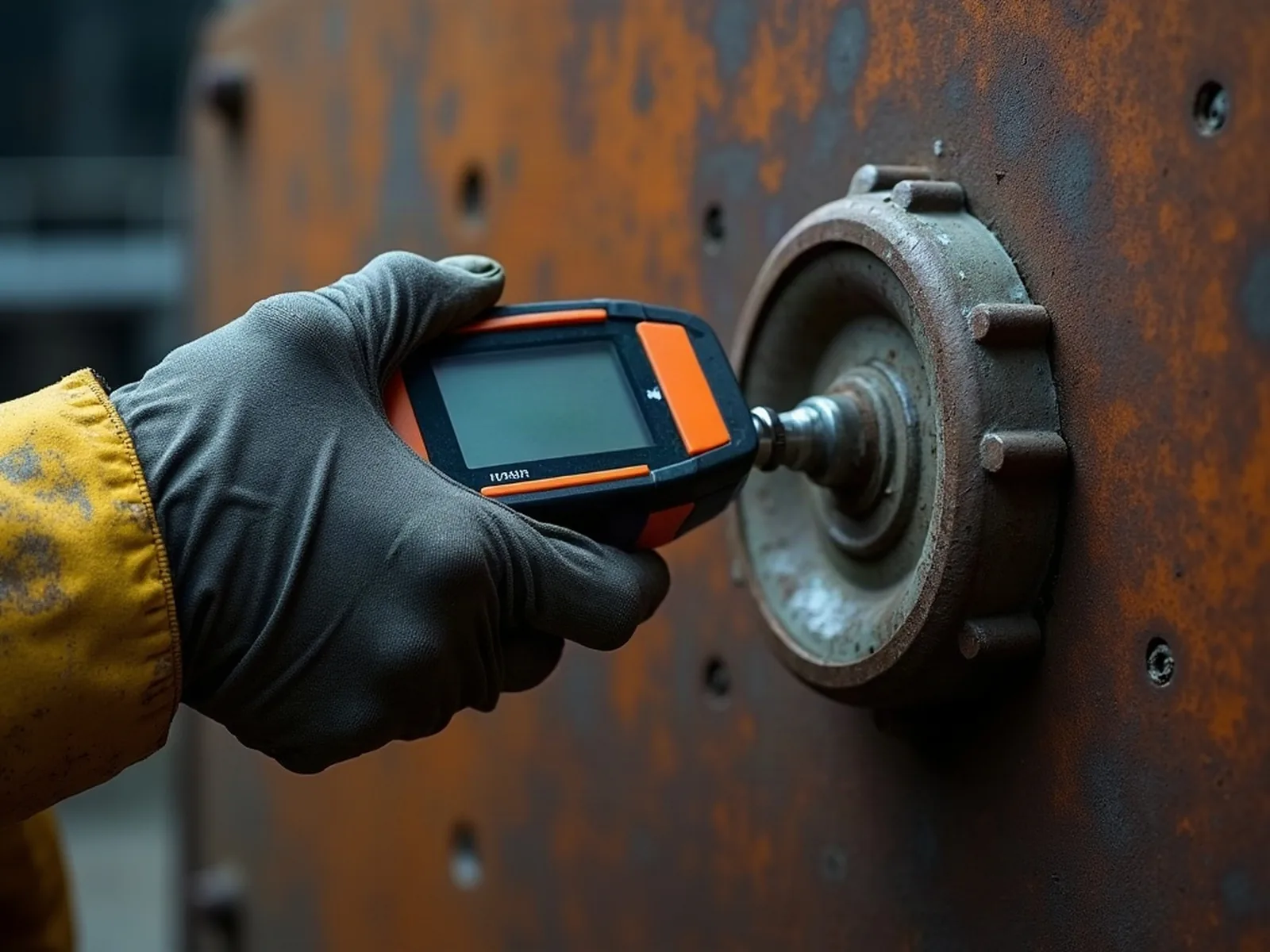
A hull and machinery survey measures structure and propulsion rather than describing them. It combines ultrasonic thickness measurement of steel or aluminium plating, close-up structural examination, machinery condition assessment and a running trial, and reports wastage as numbers against original scantlings.
The difference between a general condition survey and a hull and machinery survey is instrumentation. A general survey says the plating “appears sound”. An H&M survey says the strake measured 6.1 mm against an original 8.0 mm, that is 24 per cent wastage, and here is the grid it was taken on.
Ultrasonic thickness measurement (UTM): what we actually do
UTM sends a high-frequency pulse through the plate and times the echo from the far face. It is non-destructive, it works through paint only if the coating is thin and sound — otherwise the spot is ground back to bright metal — and its value depends entirely on where the readings are taken.
- Grid planning. Readings are planned against the structural drawing where one exists, or against a measured frame layout where it does not. Random spot readings are close to useless.
- Preparation. Scale and loose coating removed at each point, couplant applied, probe calibrated on a reference block of known thickness at the working temperature.
- Priority areas. Waterline and boot-top, bilge strakes, ballast and fuel tank boundaries, under-engine bedplate, chain locker, transom and shaft-log surrounds, and any area of known previous repair.
- Recording. Every reading logged with its location on a plate diagram, not as a loose list. Minimum, maximum and mean per plate.
- Assessment. Wastage expressed as a percentage of original or as-built thickness, with renewal recommendations where wastage exceeds the accepted allowance for that structure.
| Structure | Typical wastage allowance before renewal is advised | Why it matters |
|---|---|---|
| Shell plating, general | 20 % | Loss of hull girder strength and puncture resistance |
| Shell plating, waterline / boot-top | 15 % | Highest corrosion rate zone, wet-dry cycling |
| Deck plating in way of hatches | 20 % | Watertight integrity and local buckling under load |
| Internal structure (frames, girders) | 25 % | Section modulus loss; harder to inspect, easier to hide |
| Tank boundaries (ballast, fuel) | 15 – 20 % | Cross-contamination and pollution risk |
Machinery: what a running trial reveals that a static inspection cannot
Running trial observations
- Cold-start behaviour, smoke colour and duration, and whether starting aids are being used to mask compression loss.
- Exhaust gas temperature spread across cylinders, where instrumentation allows — an outlier usually means an injector or a valve.
- Crankcase pressure and blow-by at the breather, a direct indicator of ring and liner condition.
- Gearbox oil temperature and pressure under load, and clutch engagement without slip on both ahead and astern.
- Shaft alignment symptoms: vibration signature by RPM, cutless bearing play, stern-gland heat and drip rate.
- Charging behaviour under real electrical load, and whether the battery bank actually accepts charge.
- Cooling: raw-water flow, heat-exchanger differential, header-tank condition and any oil in the coolant or coolant in the oil.
Oil analysis — the least costly evidence on the vessel
A laboratory oil sample from each main engine and the gearbox costs a fraction of the survey and frequently changes the negotiation. Wear metals identify which component is degrading — iron for liners and rings, copper and lead for bearings, chromium for rings, silicon for dirt ingress. Water or glycol in the oil points at a head gasket, a liner seal or an oil cooler. We take samples on request and report the laboratory result as an appendix with its own interpretation.
Aluminium and GRP hulls are measured differently
Ultrasonic thickness measurement works on aluminium but the acceptance criteria and the failure modes differ: the real risks are galvanic corrosion around dissimilar-metal fastenings, crevice corrosion under fittings and stress cracking at hard points. On GRP there is no thickness measurement in the steel sense; the instruments are a moisture meter with a stated scale, percussion sounding for delamination, and where the buyer accepts it, a small number of core samples in agreed locations with agreed making-good.
Frequently asked questions
What is ultrasonic thickness measurement used for?
To establish how much of the original plate thickness remains after corrosion, so that wastage can be reported as a number and compared against a renewal threshold. It is the only non-destructive way to assess steel hull condition with confidence.
Does the vessel have to be out of the water for UTM?
For the shell below the waterline, yes in practice — readings need a prepared, accessible surface. Internal readings from within tanks and voids can be taken afloat, and are often more revealing.
How many readings should a hull and machinery survey take?
It depends on size and structure rather than a fixed number. A 30 m steel workboat typically needs several hundred points to produce a defensible thickness map; a handful of spot readings is not a survey, it is an anecdote.
Can you survey machinery without opening it up?
Yes — condition assessment is non-invasive by default: running observation, temperatures and pressures, oil condition, laboratory analysis and endoscope inspection where access allows. Opening up is a separate scope agreed with the owner.
Do you carry out class-required thickness measurement?
Thickness measurement for class renewal must be carried out by a firm approved by the relevant class society and witnessed by the class surveyor. We carry out owner’s and buyer’s UTM for condition, valuation and insurance purposes, and we will say plainly in the report which of the two you are receiving.
What if the hull has been repaired before?
Previous repair areas get extra readings and close visual attention, because a patch welded over wasted plate is common and rarely documented. Doublers are recorded as findings, not as repairs.
Can you do this on a wooden hull?
Not by ultrasonics. Timber is assessed by pick test, moisture meter, fastening withdrawal and seam examination — see wooden-boat surveys.
Book a hull & machinery survey
Tell us the vessel, port, cargo and date window. Our commercial and cargo desk confirms surveyor availability and a written scope before attendance.
WhatsApp +6281139414563 bd@juaraholding.com
Commercial & cargo desk · fees quoted in USD · report issued in English