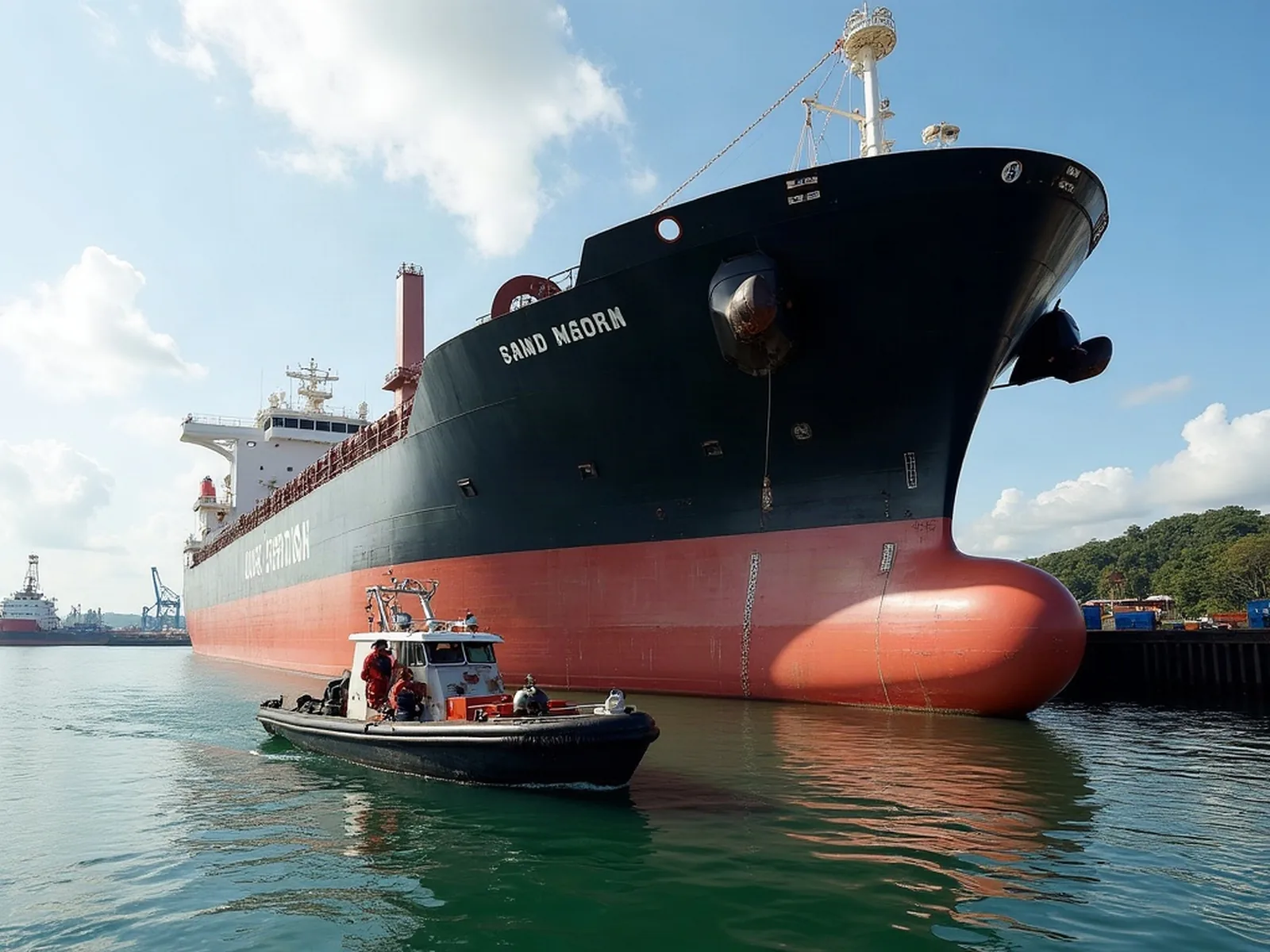
Draft, bunker and cargo surveys establish quantity and condition at the moment of transfer. Draft survey weighs cargo by displacement, bunker survey measures fuel received or remaining on board, and cargo survey records condition, stowage and outturn. All three protect whoever is paying against a number they cannot otherwise verify.
Indonesia moves an enormous tonnage of coal, nickel ore, bauxite, CPO, cement and general cargo through terminals where the shore scale is either absent, disputed or owned by the counterparty. Draft survey is how that tonnage is actually settled, and a one per cent error on a 60,000 tonne coal parcel is not a rounding difference.
Draft survey: how the number is produced
A draft survey does not measure cargo. It measures the vessel, twice, and takes the difference. The arithmetic is unforgiving and the errors are all in the fieldwork.
- Read six draughts. Forward, midship and aft on both sides, read from a launch at water level — never from the quay, never from the deck. Sea state is estimated and the mean of the wave crest and trough is taken.
- Correct for trim. First trim correction using the change in tonnes per centimetre; second trim correction using the rate of change of the longitudinal centre of flotation. Both come from the vessel’s own hydrostatic tables.
- Correct for hog or sag. The mean of means calculation weights the midship reading heavily because hull deflection is the largest single source of error on a long hull.
- Correct for density. Dock water density is measured with a calibrated hydrometer from samples at the vessel’s mean draught, not from the surface.
- Deduct all non-cargo weights. Ballast — every tank sounded and temperature corrected — fresh water, fuel, lube oil, slops, stores and constant. Ballast is where draft surveys are won and lost.
- Repeat on completion. Cargo quantity is the difference between the two displacements, corrected identically.
| Error source | Typical impact on a 50,000 t parcel | How we control it |
|---|---|---|
| Draught misread by 1 cm | Up to ~60 t | Read from a launch, both sides, twice, by two people |
| Density sample taken at surface | 0.1 – 0.4 % | Sample at mean draught depth, temperature corrected |
| Un-sounded or partly full ballast tank | Hundreds of tonnes | Every tank sounded by us at both surveys, including voids and peaks |
| Hog / sag ignored | 0.2 – 0.5 % | Full mean-of-means with midship weighting |
| Constant assumed rather than derived | Variable and systematic | Constant derived at the initial survey and carried consistently |
Bunker surveys: quantity, quality and the wedge
Bunker quantity survey is instructed at delivery, at redelivery, on charter handover, and whenever a vessel and a supplier disagree. The work is tank-by-tank gauging with temperature profiles, volume correction to a standard temperature, and density from a representative sample.
Bunker survey working method
- Gauge every bunker tank before and after transfer — ullage or sounding, with tables and trim/list corrections applied.
- Take temperature at three depths in each tank; heated fuel oil tanks stratify and a single reading misstates volume.
- Correct observed volume to 15 °C using the correct correction table for the product.
- Take a representative drip or line sample, seal it, and split it between vessel, supplier and surveyor for retention.
- Where a tank has a trapped quantity below the suction, calculate it as a wedge — trim and list make this the single most disputed figure in bunkering.
- Record the barge figures, the vessel figures and our figures side by side, and state the difference plainly rather than reconciling it away.
Cargo surveys: loading, discharge, outturn and tally
Cargo survey work runs from pre-loading hold inspection through to outturn. What matters changes with the commodity, and a surveyor who treats bagged cement the same as nickel ore is not much use.
| Cargo | Critical checks | Common dispute |
|---|---|---|
| Coal | Moisture and TML where relevant, hold cleanliness, self-heating monitoring, draft survey quantity | Quantity difference against shore belt weigher |
| Nickel / bauxite ore | Transportable moisture limit and can test, liquefaction risk, hold condition | Moisture content at loading and cargo shifting |
| General / project cargo | Pre-shipment condition, lashing and securing, lift plan witness | Damage attributed to stowage versus pre-existing |
| Bagged cargo (cement, fertiliser) | Tally count, bag condition, hold dryness, dunnage and ventilation | Shortlanded bags and torn-bag sweepings |
| CPO and liquid bulk | Tank cleanliness and prior cargo, temperature at loading, sampling | Contamination and quantity at outturn |
| Containers | Seal integrity, container condition, stow position, reefer temperature logs | Water damage and reefer failure |
Ask a surveyor: appointing a draft surveyor for a coal parcel in Kalimantan
Most Kalimantan coal loads at anchorage from barges into a geared bulk carrier, sometimes over several days and in monsoon conditions. That changes the survey in three ways. First, the initial and final draft surveys are separated by a long window in which the vessel takes and discharges ballast continuously, so the ballast record has to be ours and continuous, not the vessel’s summary. Second, freshwater rain accumulating in holds and on deck is real weight — it is recorded and deducted. Third, barge-by-barge tally and moisture sampling run alongside the draft survey, because the seller’s barge figures and the vessel’s draft figure will not agree and someone has to say why.
Give us the anchorage, the vessel and the expected loading window with as much notice as you can. Surveyor mobilisation to Taboneo, Muara Berau, Muara Pantai or Kotabaru involves boat transfer and sometimes an overnight stay aboard, and a survey rushed onto a vessel already loading has lost its initial condition before it started.
Frequently asked questions
What is a draft survey used for?
To determine cargo quantity loaded or discharged by measuring the vessel’s displacement before and after, corrected for density, trim, hull deflection and all non-cargo weights. It is the accepted method where a shore weighbridge is unavailable or disputed.
How accurate is a draft survey?
Carried out properly, in reasonable conditions, on a vessel with good hydrostatic data, commercial practice puts it at around ±0.5 per cent. Poor sea state, unreadable draught marks, unsounded ballast or bad tables degrade that quickly, and the report states the conditions.
What is included in a bunker survey?
Tank-by-tank gauging with temperature profiles before and after transfer, volume correction to 15 °C, density from a representative sample, wedge calculation for partly filled tanks, and a statement of the difference between vessel, barge and surveyor figures.
What is an on-hire and off-hire survey?
A condition and quantity record taken at delivery and redelivery under a time charter — bunkers remaining on board, hold and tank cleanliness, and existing damage — so that responsibility for change during the charter is clear. See the on-hire and off-hire guide.
Who needs a cargo survey?
Anyone carrying the risk on the cargo at that moment: the seller before loading, the buyer at outturn, the charterer under the charterparty, the underwriter after damage. Terminals sometimes instruct their own for the same reason.
Can you attend at anchorage and at barge-loading operations?
Yes. Most of our Kalimantan and Sulawesi draft survey work is at anchorage with barge feeding, including overnight attendance where the loading window requires it.
Do you issue a certificate of quantity?
We issue a draft survey report with the full calculation shown. Where the parties require a certificate format for payment purposes we can issue one as well, referenced to the report.
Do you do sampling and moisture testing for ore cargoes?
We take and seal samples and witness sampling procedures. Laboratory determination of moisture content, TML and flow moisture point is carried out by an accredited laboratory and reported as an appendix with the laboratory’s own certificate.
Appoint a draft, bunker or cargo surveyor
Tell us the vessel, port, cargo and date window. Our commercial and cargo desk confirms surveyor availability and a written scope before attendance.
WhatsApp +6281139414563 bd@juaraholding.com
Commercial & cargo desk · fees quoted in USD · report issued in English