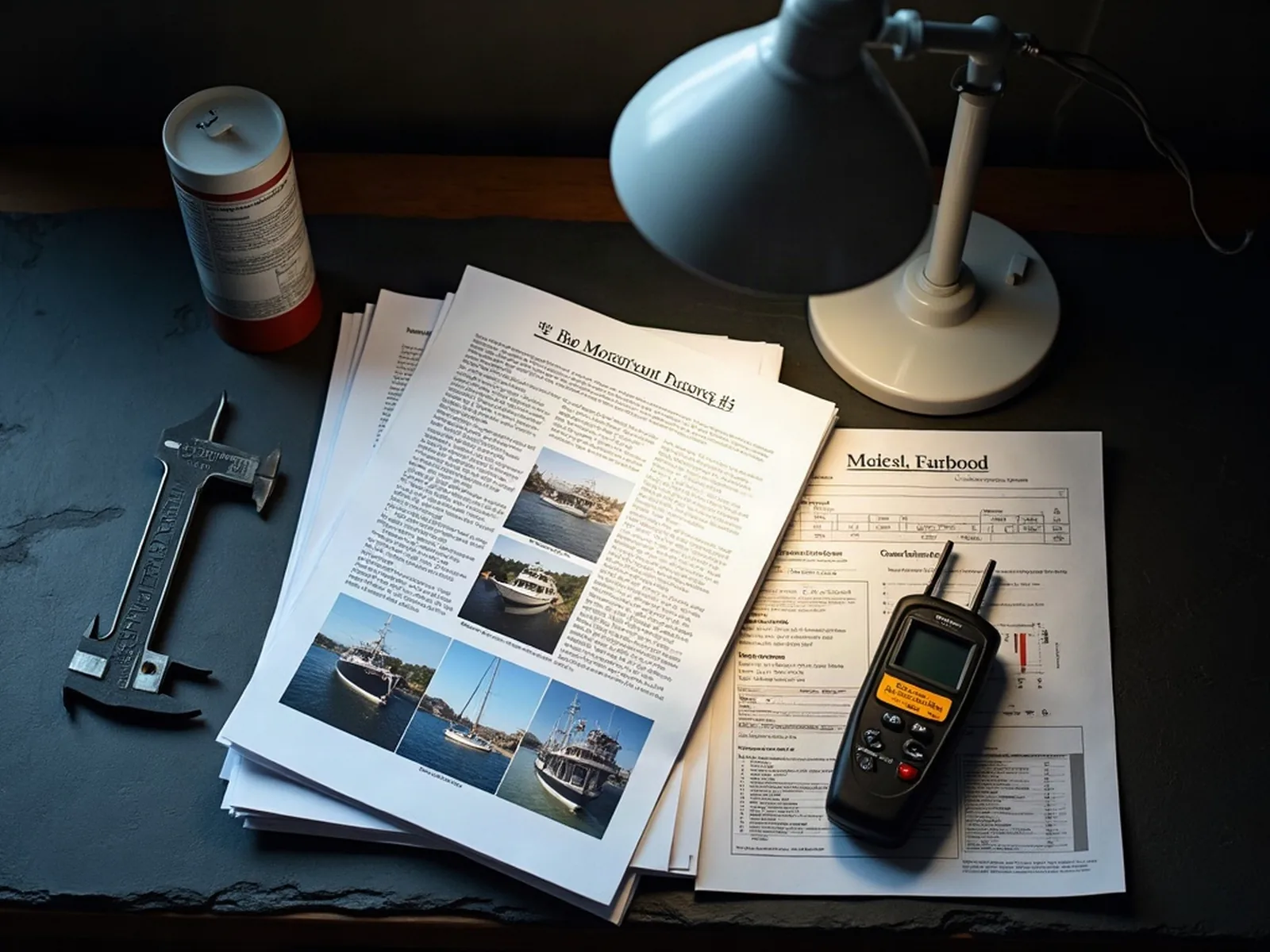
A marine survey report states what was inspected, what was found, what it means and what should be done about it. A usable report carries scope and limitations, a photographic record, measured data where instruments were used, a defect list graded by urgency, and a conclusion that answers the question you asked.
The report is the product. Everything else — the attendance, the instruments, the experience — exists to produce a document that a buyer, an underwriter, a bank or a lawyer can rely on. This page sets out what ours contain and how to read one, including someone else’s.
The anatomy of a survey report
| Section | What it must contain | What to check when you read it |
|---|---|---|
| 1. Instruction and purpose | Who instructed, for what purpose, on what date | That the stated purpose matches yours — an insurance survey is not a purchase decision |
| 2. Vessel particulars | Name, type, build year and builder, dimensions, tonnage, hull identification, engines and serials, registration | That serial numbers and hull identification were physically verified, not copied from the listing |
| 3. Scope and limitations | Exactly what was and was not inspected, and why | The most important section in the report. Anything not inspected is not covered by the conclusion |
| 4. Condition findings by system | Hull, structure, machinery, systems, safety, accommodation | That findings are described with location and consequence, not just labelled |
| 5. Measured data | Thickness readings on a plate diagram, moisture readings with the scale used, sea trial figures | That numbers appear at all — a survey without data is an opinion |
| 6. Photographic record | Referenced photographs tied to findings | That defect photographs carry a scale reference and can be located on the vessel |
| 7. Defect list, graded | Urgent / short-term / monitor, with recommended action | That grading is justified and not everything is ‘recommended’ |
| 8. Valuation opinion (where in scope) | Market value, method used, comparable or cost evidence | That the method is stated and the working shown |
| 9. Conclusion | A direct answer to the instruction | That it actually concludes rather than restating the findings |
| 10. Surveyor’s declaration | Independence, qualifications, terms and limitations of liability | That the surveyor declares no interest in the transaction |
How defect grading works
| Grade | Definition | What you should do |
|---|---|---|
| Urgent | Affects safety, watertight integrity, structural strength or ability to proceed to sea | Rectify before use, before completion of purchase, or before cover incepts |
| Short-term | Will develop into a serious defect, or affects reliability and compliance | Plan and budget within 3 to 12 months; often the basis of a price renegotiation |
| Monitor | Normal wear or an early-stage condition needing observation | Record and re-inspect at the next survey or docking |
| Advisory | Not a defect — an improvement, an efficiency point, or a note for the owner | Optional; useful for planning |
How to read a report you did not commission
Sellers frequently offer a previous survey. It may be genuinely useful. It may also be a document produced for a different purpose, by someone appointed by the other side, on a vessel that has since changed. Check these six things:
- Who instructed it, and when. A survey commissioned by the seller for their own insurance is not a purchase report, and a two-year-old survey on a working vessel in the tropics is background, not evidence.
- The limitations section. If the vessel was not hauled out, the entire underwater hull is uninspected — no matter how positive the rest of the document sounds.
- Whether instruments were used. Look for thickness readings, moisture readings with a stated scale, sea trial figures. Adjectives are not data.
- Whether recommendations were closed out. Ask for dated evidence that each urgent and short-term item was actually rectified, and by whom.
- The photographs. Check that defect photographs exist and are referenced. A report with only general views of a clean boat has not looked hard.
- The declaration. An independence declaration and a named surveying organisation with contactable details. If it is anonymous, treat it as marketing.
Sample report
We provide a redacted sample report on request — the structure, the grading, the photographic convention and the declaration, with vessel identity and client details removed. Ask at the brief stage and we will send it before you commit, so you know exactly what you are buying. The sample sets are described on our sample reports page.
Format and delivery
Deliverable format
- PDF in English, paginated, with a photographic appendix and any laboratory certificates attached.
- Delivered by email to the instructing party only. We do not circulate reports to brokers, yards or sellers without written instruction.
- Thickness data supplied as a plate diagram plus a tabulated list, not as loose readings.
- An Indonesian-language summary can be added on request — see jasa survey kapal.
- Reports are retained so that a later re-inspection can be reported as a dated addendum against the original.
Frequently asked questions
What is in a marine survey report?
Instruction and purpose, vessel particulars, scope and limitations, condition findings by system, measured data, a photographic record, a graded defect list, a valuation opinion where in scope, a conclusion and the surveyor’s declaration.
How to read a marine survey report?
Start with the scope and limitations section, then the graded defect list, then the conclusion. Read the findings in detail last. Most misreadings happen because people start at the summary and never check what was excluded.
How long is a typical report?
Twenty to sixty pages for a leisure vessel including photographs, and considerably more for a commercial vessel with a full thickness measurement appendix.
Can I share the report with my insurer or bank?
Yes — it is your report. Tell us at the brief stage if it is intended for a specific underwriter or lender and we will format the recommendations and valuation accordingly.
Do you provide a sample report?
Yes, redacted, on request before you commit.
How long is a survey report valid?
There is no formal expiry, but underwriters generally want a condition survey within the last two to five years depending on vessel age, and lenders usually want a valuation within three to six months of drawdown.
Can the report be updated after repairs?
Yes. A close-out re-inspection produces a dated addendum confirming which recommendations were rectified and how, which is normally what an underwriter wants to see.
Will the report tell me what the vessel is worth?
A market-value opinion is included in pre-purchase and condition surveys. A formal valuation with full method disclosure is a separate engagement.
Ask for a sample report
Send the vessel details, the port where she lies and your target date. We reply with surveyor availability, a written scope and a fee band before anyone boards.
WhatsApp +628113823875 sales@komodoluxury.com
Yacht & leisure desk · fees quoted in USD · report issued in English