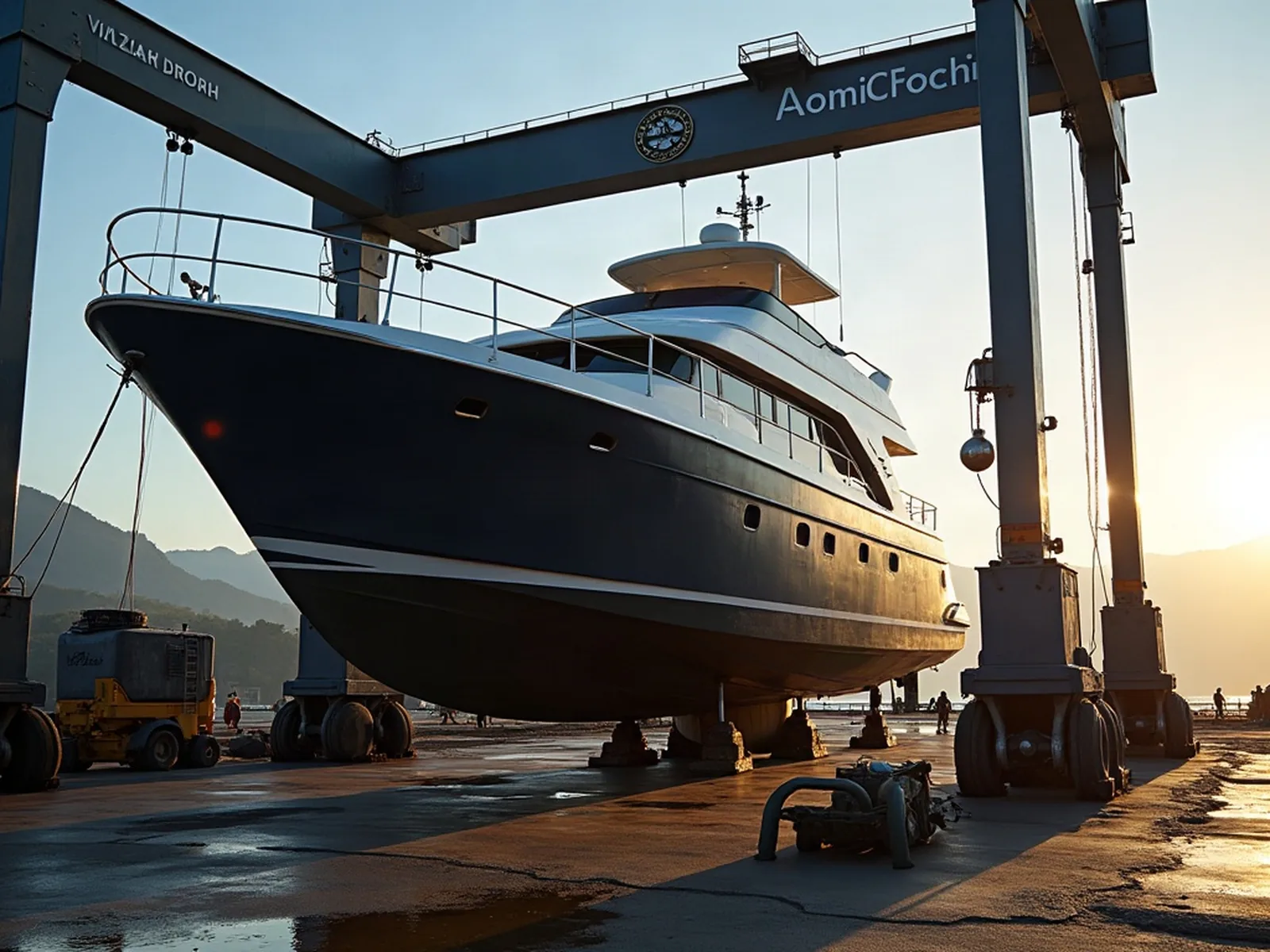
Yacht and boat surveys cover motor yachts, sailing yachts, catamarans, sportfishing boats and RIBs. The inspection changes with the construction: GRP needs moisture and delamination work, aluminium needs galvanic and crack examination, and every one of them needs a sea trial before a buying decision is made.
The label “yacht survey” hides a lot of variation. A 12 m GRP sportfisher that has spent ten years in 30 °C water has almost nothing in common, structurally, with a 24 m aluminium expedition boat or a 40 m composite catamaran. This page sets out what actually differs, so you can brief a surveyor properly rather than accepting a generic scope.
By construction: what we look for
| Construction | Primary risks in Indonesian waters | Instruments and method |
|---|---|---|
| GRP / composite | Osmotic blistering, laminate moisture, bulkhead tabbing failure, core saturation in decks, gelcoat crazing at hard points | Moisture meter with a stated scale, percussion sounding, thermal observation, agreed core samples |
| Aluminium | Galvanic corrosion at dissimilar fastenings, crevice corrosion under deck fittings and insulation, stress cracking at welds and hard points, poultice corrosion under wet insulation | Close visual, ultrasonic thickness, dye penetrant on suspect welds, bonding and anode survey |
| Steel | General and pitting corrosion, wastage at waterline and bilge strakes, doubler plates hiding wasted structure | Ultrasonic thickness on a planned grid, coating grading, tank internals |
| Timber / traditional | Fastening sickness, seam and garboard condition, rot at bulkhead ends and under sole, marine borer | Pick test, moisture meter, fastening withdrawal sample, seam probing — detailed here |
| Ferrocement | Rust-jacking at armature, delamination, poor original consolidation | Sounding, cover meter where available, crack mapping |
By vessel type: what changes
Motor yachts and sportfishing boats
Machinery dominates the risk. Two high-output diesels with 2,000 hours in tropical service, often running at high load in humid air, wear differently from the same engines in temperate use. We concentrate on exhaust elbows and risers, turbocharger condition, gearbox behaviour under load, shaft alignment and cutless bearing play, plus a full electrical load test — generators and air conditioning are the two systems that most often fail an otherwise clean survey.
Sailing yachts
Rig and keel dominate. Standing rigging age matters more than appearance: stainless wire and swage terminals in the tropics work-harden and crevice-corrode from the inside, and a rig over ten years old is a finding regardless of how it looks. Keel-to-hull joint, keel bolts, chainplates and their bulkhead attachment, rudder bearings and the steering quadrant get close attention. Sail inventory and running rigging are recorded but they are consumables, not structure.
Catamarans and multihulls
The load paths are the story. Bridge-deck to hull attachment, forward and aft crossbeams, the nacelle underside where slamming loads land, and bulkhead tabbing all take cyclic loading a monohull never sees. Composite cores in the bridgedeck and in dagger-board cases are the common saturation points. On sailing catamarans we also check for asymmetric rig loads showing up as distortion in one hull.
RIBs, tenders and small craft
Tube condition, transom integrity, hull-to-deck joint and outboard mounting. Tube fabric in tropical UV has a shorter service life than the manufacturer’s temperate figure, and a delaminated seam is not economically repairable on most fabrics.
The sea trial for a leisure vessel
Sea trial observations we record
- Cold start recorded — smoke colour and duration on each engine before the seller warms her up.
- Full-throttle RPM against the propeller specification. Under-revving means overload; over-revving means slip or a lost blade edge.
- Vibration through the range with the hand on the shaft log, and again at the helm.
- Steering lock to lock, autopilot engagement, and rudder-stop condition.
- Charging under real load: air conditioning, watermaker, windlass and thrusters all together.
- Manoeuvring alongside — thruster performance, gear engagement without delay, and astern stopping.
- Alarm test where the systems allow it, and a check that alarms have not been disabled.
Where the report goes next
A yacht survey usually has three readers: you, your insurer and — if you renegotiate — the seller. We write it so all three can use it. Defects are graded urgent, short-term and monitor; each carries a plain description of consequence, not just a location; and the summary states clearly whether the vessel is fit for the use you described at the brief stage.
Frequently asked questions
How do I inspect a yacht before buying it in Indonesia?
Appoint your own surveyor, insist on a haul-out and a sea trial, and make the deposit refundable on an adverse survey. Everything else — listing photographs, seller’s assurances, a previous survey commissioned by the seller — is background, not evidence.
Do you survey catamarans?
Yes, and the scope differs from a monohull: bridge-deck and crossbeam structure, nacelle slamming damage, core moisture in the bridgedeck, and asymmetric rig loading on sailing cats.
What about osmosis on an older GRP hull?
We map blistering and take moisture readings after the hull has dried for a stated period, and we report the reading scale used. A wet hull straight out of the water gives numbers that mean nothing without that context.
Is standing rigging age a survey finding?
Yes. Most underwriters treat rigging over ten to twelve years old as due for replacement regardless of visual condition, and tropical service shortens rather than extends that.
Can you survey a yacht that is on the hard and not commissioned?
We can survey the structure, but with no sea trial and no systems under load the report will carry substantial limitations, and we will state them. It is a partial survey, priced as one.
Do you inspect tenders and davits as part of a yacht survey?
Tender, davit, crane and their load-test certification where it exists are included in the inventory and inspected visually. Load testing itself is a separate engagement.
Do you provide a valuation as part of a yacht survey?
A market-value opinion is included in the pre-purchase report. A formal valuation for a bank is a separate engagement with a stated method.
Request a yacht or boat survey
Send the vessel details, the port where she lies and your target date. We reply with surveyor availability, a written scope and a fee band before anyone boards.
WhatsApp +628113823875 sales@komodoluxury.com
Yacht & leisure desk · fees quoted in USD · report issued in English