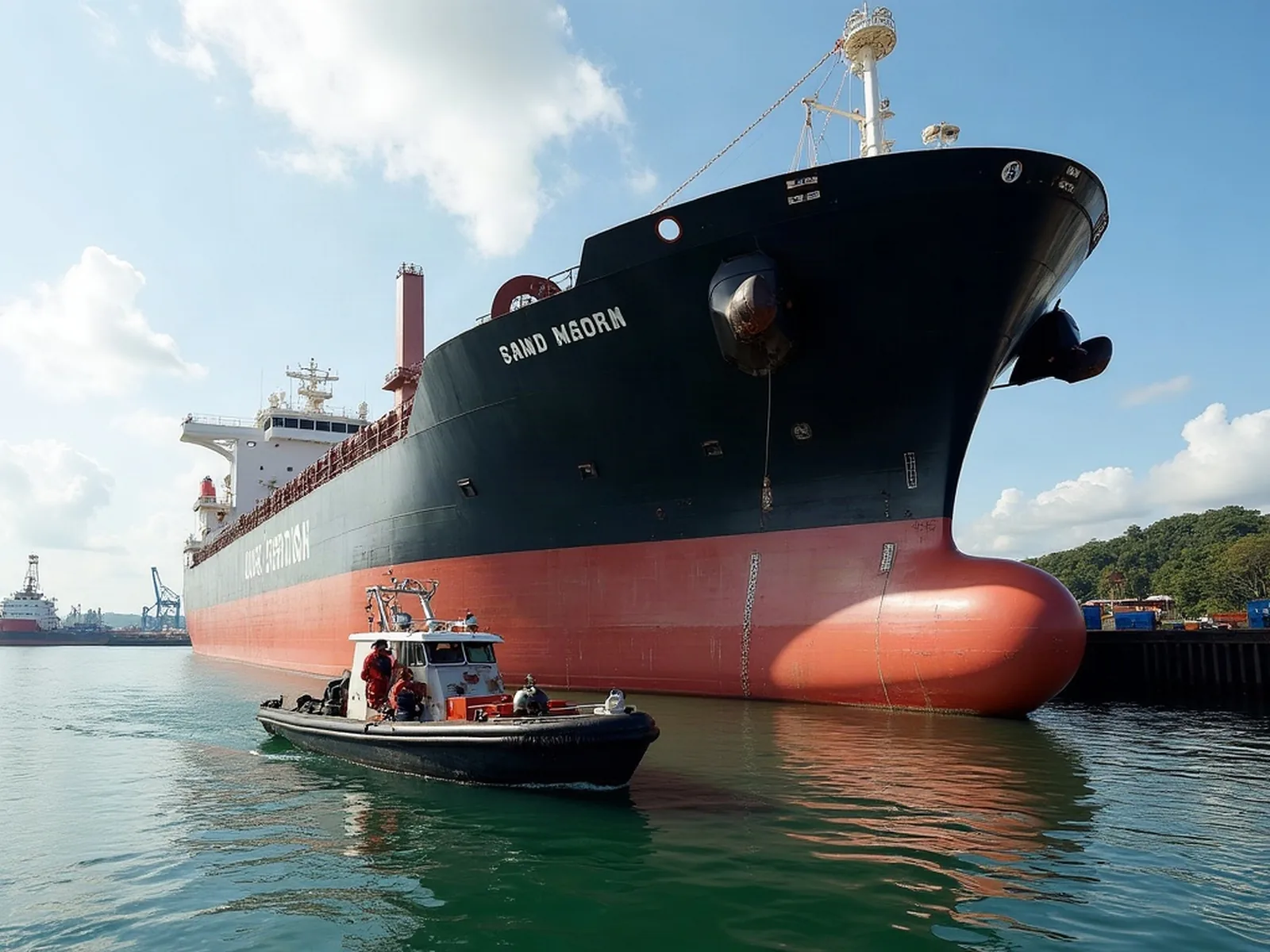
A draft survey measures cargo by weighing the vessel twice. Six draughts are read, corrected for trim, hull deflection and water density to give displacement; all non-cargo weights are deducted; and the cargo quantity is the difference between the initial and final surveys. Realistic accuracy is around half a per cent.
Draft survey is the accepted way to settle bulk cargo quantity where a shore weigher is absent or disputed — which in Indonesian coal and ore transhipment is most of the time. The method is arithmetic. The errors are all human.
The calculation, step by step
- Read six draughts — forward, midship and aft, both sides — from a launch at water level, taking the mean between wave crest and trough.
- Correct each reading to the perpendiculars, because draught marks are rarely exactly at the perpendiculars.
- Calculate the mean of means, weighting the midship reading heavily to account for hull hogging or sagging.
- Apply the first trim correction using tonnes per centimetre immersion and the longitudinal centre of flotation.
- Apply the second trim correction using the rate of change of the longitudinal centre of flotation with draught.
- Correct for water density, measured with a calibrated hydrometer from samples at the vessel’s mean draught depth and corrected for temperature.
- Deduct all non-cargo weights: every ballast tank sounded, fresh water, fuel, lube oil, slops, stores and the derived constant.
- Repeat identically on completion; cargo quantity is the difference in net displacement.
Where the money is lost
| Error | Effect on a 50,000 t parcel | Cause |
|---|---|---|
| 1 cm draught misread | Up to ~60 t | Reading from deck or quay, swell, poor marks |
| Surface density sample | 0.1 – 0.4 % | Sampling at the surface instead of mean draught |
| Unsounded ballast tank | Hundreds of tonnes | Trusting the vessel’s summary figures |
| Hog/sag ignored | 0.2 – 0.5 % | Simple mean instead of mean of means |
| Assumed constant | Systematic, variable | Taking the constant from the vessel’s papers |
| Rainwater not deducted | Tens to hundreds of tonnes | Monsoon loading, water in holds and on hatch covers |
Kalimantan-specific practice
- Loading runs for days from barges, so the ballast record must be continuous and taken by the surveyor, not summarised afterwards.
- Monsoon rain in holds and on deck is weight — recorded and deducted.
- Both sides read, twice, by two people, because swell at anchorage makes single readings unreliable.
- Barge-by-barge tally runs alongside, and the difference between barge figures and the draft figure is explained rather than smoothed away.
Frequently asked questions
How accurate is a draft survey really?
Around ±0.5 per cent in reasonable conditions on a vessel with good hydrostatic data. Rough water, unreadable marks or unsounded ballast degrade that, and an honest report states the conditions.
Who should attend a draft survey?
Whoever is paying for the cargo, and often the seller too. Joint attendance with both parties’ surveyors is normal and reduces later argument.
Can a draft survey be done at anchorage?
Yes, and in Indonesia most are. It needs a launch, competent readers and planning around the sea state.