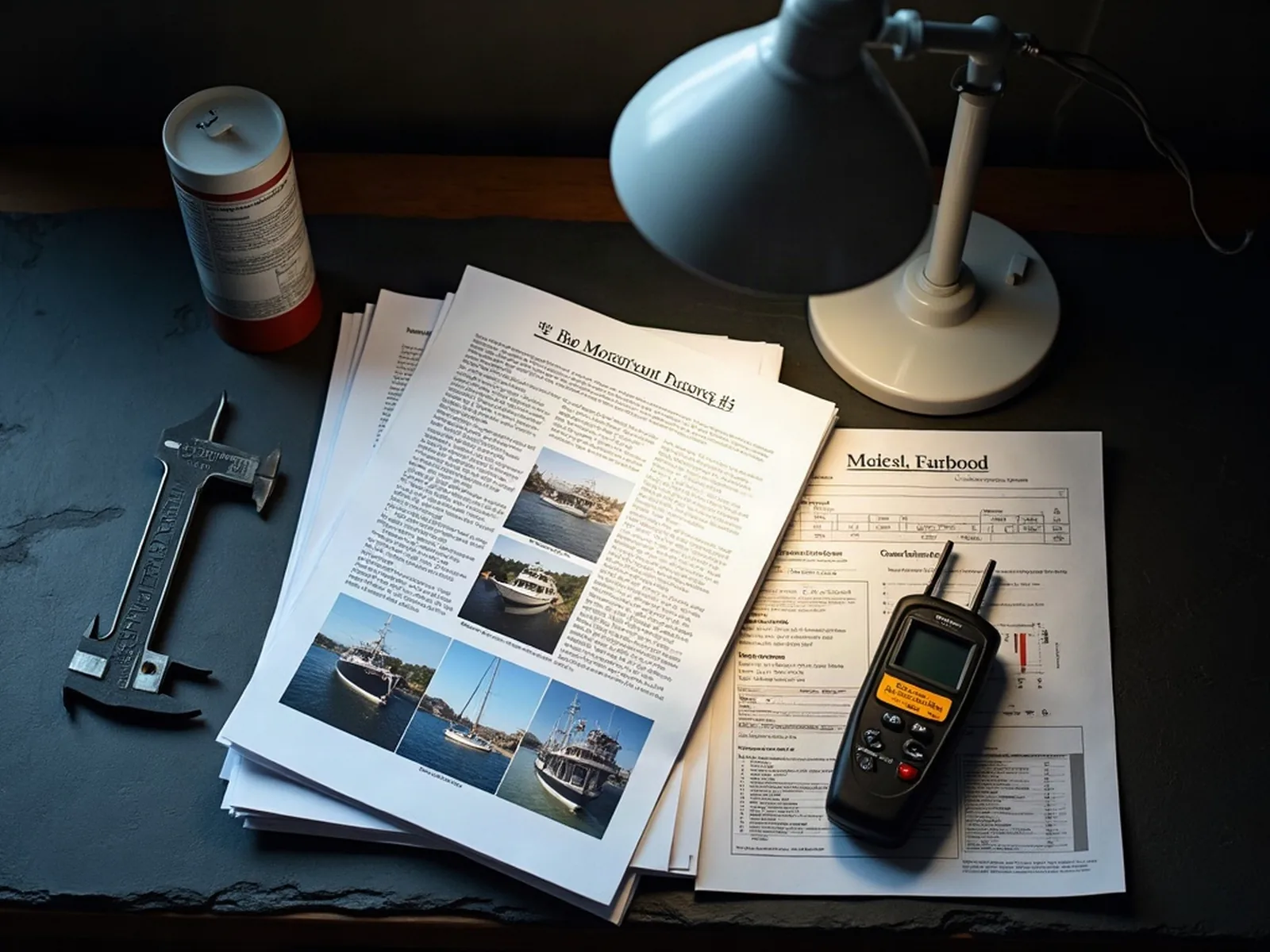
Read a survey report in this order: scope and limitations first, then the graded defect list, then the conclusion, then the detailed findings. Most people read the summary first and never check what was excluded — which is exactly how a positive-sounding report hides an uninspected hull.
Read it in this order
- Scope and limitations. What was and was not inspected. If the vessel was not hauled out, the entire underwater hull is uninspected regardless of how confident the rest reads.
- The graded defect list. Urgent items first. This is the commercial content of the document.
- The conclusion. Does it actually conclude, or does it restate findings and leave you to decide?
- Measured data. Thickness readings, moisture readings with the scale stated, sea trial figures. Numbers or nothing.
- Detailed findings. Now read the body, with the defect list beside you.
- The declaration. Independence, terms, professional indemnity.
What each grade should trigger
| Grade | What it means | Your action |
|---|---|---|
| Urgent | Safety, watertight integrity, structure or seaworthiness | Rectify before completion or before cover incepts. Price it, and take it off the offer |
| Short-term | Will become serious; affects reliability or compliance | Budget within 3 – 12 months. Usually the strongest renegotiation material |
| Monitor | Normal wear or early-stage condition | Record; re-inspect at next docking |
| Advisory | Improvement or efficiency note | Optional |
Six checks on a report you did not commission
- Who instructed it and when. A seller’s insurance survey is not a purchase report, and a two-year-old report on a tropical working vessel is background.
- Limitations. No haul-out means no underwater assessment. Full stop.
- Instruments. Look for numbers. Adjectives mean the surveyor carried a torch and nothing else.
- Close-out evidence. Ask for dated proof each urgent item was actually rectified, by whom.
- Photographs. Defect photographs with scale, referenced to findings. General shots of a clean boat prove nothing.
- Declaration. A named practice, contactable, declaring independence. Anonymous means marketing.
Language that should slow you down
| Phrase in a report | What it often means |
|---|---|
| “Appears satisfactory” | Looked at, not tested |
| “Not accessible at the time of survey” | Uninspected — check whether it matters |
| “Consistent with age and use” | A judgement, not a measurement |
| “Recommend further investigation” | The surveyor saw something and could not resolve it. Resolve it before you buy |
| “Vessel found in generally good condition” with no data | A conclusion with nothing behind it |
Frequently asked questions
What is in a marine survey report?
Instruction and purpose, vessel particulars, scope and limitations, findings by system, measured data, photographs, a graded defect list, valuation opinion where in scope, a conclusion and the surveyor’s declaration.
How long should a survey report be?
Twenty to sixty pages for a leisure vessel with photographs; considerably more for a commercial vessel with a thickness appendix. Length is not quality, but a five-page report on a 20 m vessel is a warning.
Can I ask the surveyor to explain the report?
Yes, and you should. One round of written clarification is part of our engagement.